Read the label.
Resolve the order.
A reel label, a device top mark and a BOM line can tell different parts of the same story. Keep the original fields separate, then resolve differences before requesting a quotation.
Read the fields.
Ask the right questions.
Start with the brand, then select a numbered field. Compare manufacturer labels, distributor records and device markings. English label-layout illustrations also cover NXP, Intel / Altera and onsemi.
Manufacturer reel label
Nexperia
PMEG4010CEJ,115
Select a marker on the image or a number below. Each field answers a different purchasing question.

Device type
TYPE identifies the device. The separate OPN line below adds the ordering form. A shortened BOM entry should be reconciled with both fields.
Lot identity
The LOT field connects this reel with its traceability records. Keep it separate from the date field and the manufacturer code number.
Pack quantity
QTY describes the illustrated pack. A partial reel or split delivery needs its own agreed quantity and packing record.
Printed date field
Record the DATE field exactly as printed. Date-code acceptance should be agreed against the manufacturer’s convention and the offered lot.
Manufacturer code number
CODENO is a separate identifier. It is useful when reconciling the reel, original box and quotation, but it does not replace the OPN.
Complete ordering form
The OPN retains the comma and 115 suffix. Compare that full form with the quoted packing option before placing an order.
For this diode, confirm the complete OPN, reel or cut-tape requirement, quantity and accepted date-code range before ordering.
Discuss this requirement ↗Manufacturer packaging label
Texas Instruments
CSD87588N
Select a marker on the image or a number below. Each field answers a different purchasing question.
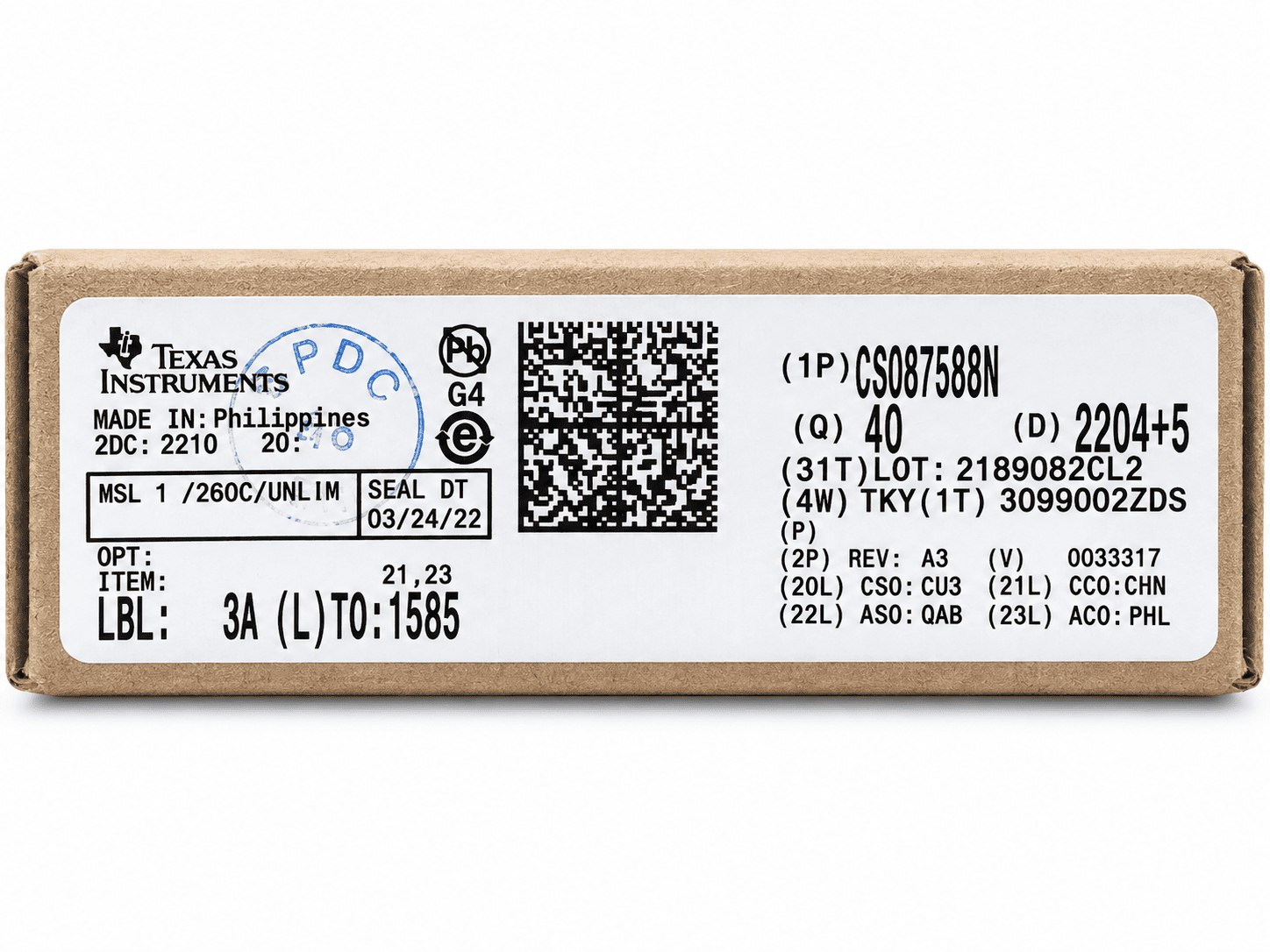
Manufacturer part
The (1P) field identifies the device on this box. Keep the complete orderable code from the quotation alongside it when a carrier suffix is required.
Quantity
The (Q) line states the pack count shown here. It is separate from the quantity currently offered for your build.
Date code and lot
Keep the full date string, including +5, and the LOT line. Do not turn a shortened date string into a more precise manufacturing date.
Seal and handling
The seal date records a packaging event. The handling line records moisture and peak-temperature information; neither replaces the part identity.
Revision field
Retain the printed REV value. It is not, by itself, evidence of a particular electrical design revision; use the relevant TI product or change documentation.
Manufacturing locations
The label records more than one manufacturing step. Preserve each field rather than deriving the device’s origin from the seller’s shipping address.
For CSD87588N, keep the offered order code, original lot fields, quantity and packing requirements together.
Discuss this requirement ↗Distributor packaging label
Microchip
USB5744BT-I/2GX01
Select a marker on the image or a number below. Each field answers a different purchasing question.
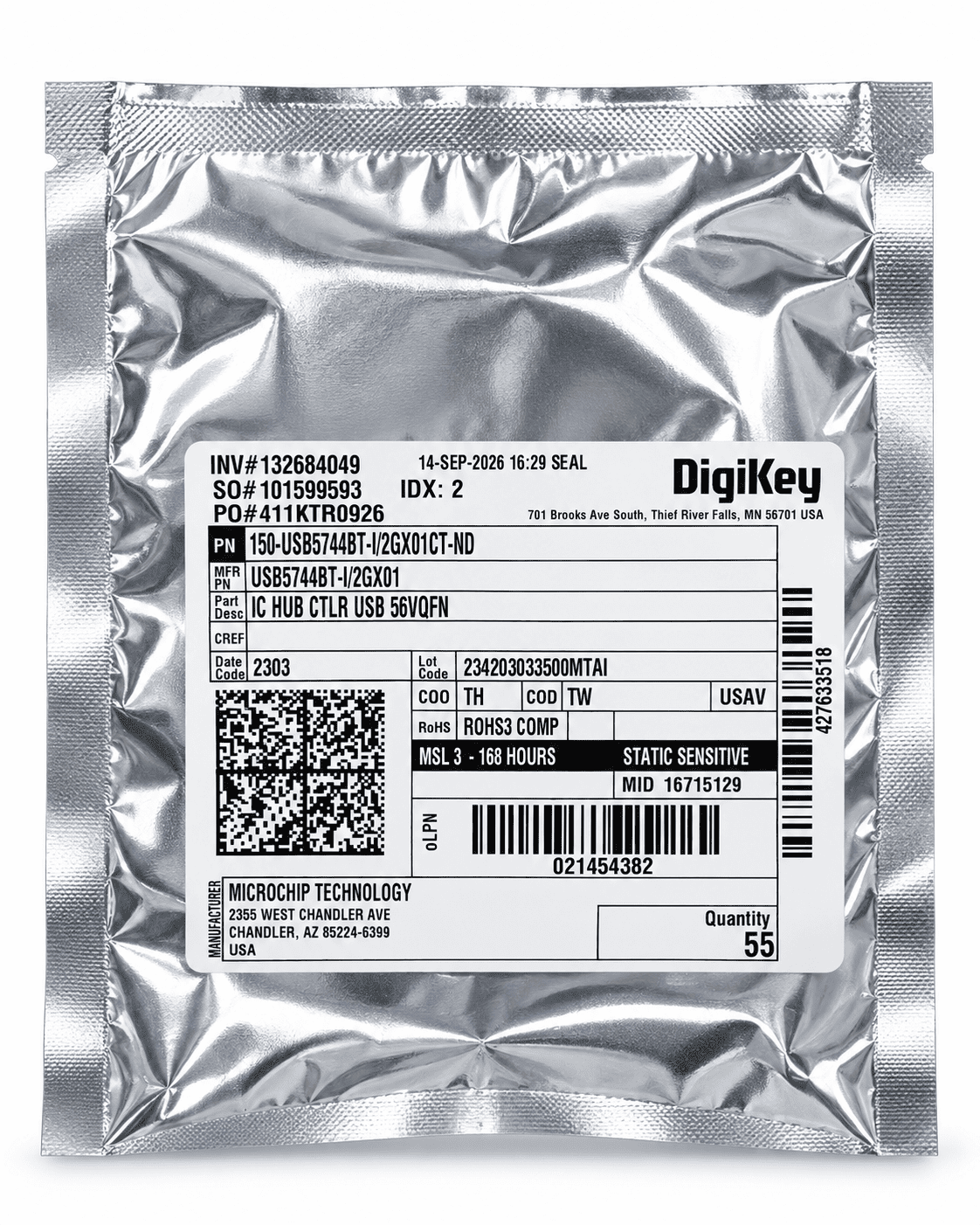
Manufacturer versus distributor code
MFR PN is the Microchip identifier. The longer PN above is a distributor catalogue code and includes its own fulfilment suffix.
Lot and date
The date and lot occupy separate fields. Keep both when asking for one-lot material or checking whether a split shipment meets your receiving rules.
Seal timestamp
This is the distributor’s seal record. It does not establish the silicon manufacturing date or the entire storage history.
Moisture handling
Read the handling line alongside the applicable conditions and package record. Repacking may require additional handling evidence.
Pack quantity
The illustrated distributor pack carries its own quantity. A distributor cut-tape count is not the manufacturer’s standard full-reel quantity.
For this USB hub, retain /2GX01 and confirm the accepted carrier, lot and moisture-handling record.
Discuss this requirement ↗Packaging-handling label
STMicroelectronics
Moisture-handling record
Select a marker on the image or a number below. Each field answers a different purchasing question.

Sensitivity level
This caution label states moisture sensitivity. It does not contain the complete device order code; keep the product label or top mark with it.
Bag seal date
The seal date is a packaging event. If the bag has been opened or resealed, ask for that history separately.
Peak package temperature
This value concerns package assembly processing. It is not the permitted operating temperature of an STM32 device.
Exposure window and conditions
Read the time together with its stated conditions. A clock without temperature and humidity context is not a complete handling record.
Storage and baking references
The lower text describes storage and actions if conditions are exceeded. Baking must follow the applicable device, carrier and process requirements.
Pair this handling record with the complete STM32 ordering code, lot identity and any revision restrictions.
Discuss this requirement ↗Connect the ordering code to the goods.
Follow an H757 example from the request and supplier offer to a product label and device top mark. Check the marking rule for the actual package.
Read the video transcript
Here's a small detail from our H seven fifty-seven tray photo. The device name continues onto the next line. That six A belongs with the identification above it.
Keep both lines when checking the complete part number. We use the manufacturer's marking rules for that package, rather than assuming everything appears on one line.
On this product label, the five one one prefix belongs to the distributor's catalogue number. The manufacturer part number is a separate field.
Compare that field with the customer's approved requirement and the supplier's offer. Then reconcile the batch references for the material being offered.
The moisture label gives handling information. Its bag seal date is not the chip's manufacturing date. These photographs illustrate the checks; they do not establish one verified lot.
For a G four purchase, keep the same discipline. Confirm suffixes, packing and any lot or revision restrictions before ordering. If something doesn't agree, we flag it.
Send the full part number, quantity, arrival date and special requirements. We'll check the offered-material details against that request.
Manufacturer product label
AMD / Xilinx
XC6SLX9-2FTG256I
Select a marker on the image or a number below. Each field answers a different purchasing question.

Complete FPGA code
Retain the device, speed, package and final grade character. An offer for XC6SLX9 alone leaves essential ordering details unresolved.
Printed date code
DATE CODE is a distinct field. Keep it with the label and lot records rather than substituting a bag seal date or shipping date.
Quantity on this label
This manufacturer label shows a quantity of 346. The amount offered now, and any split-pack arrangement, must be confirmed in the quotation.
Customer product identifier
The customer product field is abbreviated in this image. It must not replace the complete manufacturer PART NUMBER above.
Moisture sensitivity
Record the MSL with the moisture-barrier bag, seal and opening history. The label alone does not tell you how long the devices have been exposed.
Peak body temperature
This is package-processing information. It is not the FPGA’s operating-temperature grade.
Diffusion and assembly
The label separately identifies country of diffusion and country of assembly. They describe different manufacturing stages.
For this FPGA, confirm -2, FTG256 and I, then agree lot, date-code and moisture-handling requirements.
Discuss this requirement ↗Laboratory submission label
Analog Devices
ADF4382BCCZ
Select a marker on the image or a number below. Each field answers a different purchasing question.

Submitted part
The P/N on this laboratory submission record identifies the material sent for review. Reconcile it with the original manufacturer label and the issued report.
Quantity and date notation
These are submission details. A date such as 25+ or 26+ is not a complete manufacturer date code, and the submitted quantity is not a live stock balance.
Laboratory reference
Use the laboratory quote or job reference to connect the submitted material with its inspection paperwork. The sticker is not the test conclusion.
Receiving laboratory
The destination identifies where this package was sent. The agreed inspection plan and issued findings are separate records.
Confirm ADF4382BCCZ versus the required packing form; agree reference-clock and RF acceptance conditions before testing.
Discuss this requirement ↗FTDI · FT2232HL
Laboratory shipment label
Select a marker on the image or a number below. Each field answers a different purchasing question.

Part and carrier notation
The shipment label includes FT2232HL and the word Tray. Reconcile the device code and the actual delivery carrier separately; a shipment note is not the manufacturer’s ordering label.
Shipment quantity
The number shown is the quantity recorded for this shipment. It is not a live stock balance or a quantity reserved for a new order.
Laboratory destination
The destination identifies where this material was sent for inspection. The test scope and findings belong in the corresponding laboratory report.
Keep the complete manufacturer label, the shipment record and the inspection report linked to the offered lot.
Discuss this requirement ↗FTDI · FT2232HL
Moisture-barrier bag label
Select a marker on the image or a number below. Each field answers a different purchasing question.
Moisture sensitivity
The photographed bag shows Level 3. Obtain a fully readable handling label and the opening history for the offered lot before agreeing assembly acceptance.
Assembly temperature
The legible temperature field shows 260°C. Keep this packaging instruction separate from the device’s operating-temperature rating, and check the applicable assembly specification.
Request a clear seal and handling record for the offered lot. Small or obscured print in a photograph should not become an assumed acceptance limit.
Discuss this requirement ↗Compare the chip’s top marking
The device photograph is a separate identity check. Compare it with the complete ordering and packaging records.
Device top marking
FTDI
FT2232HL
Select a marker on the image or a number below. Each field answers a different purchasing question.

Device marking
The visible marking identifies the HL device. Do not substitute HQ or another package merely because the FT2232H family name matches.
Additional marking lines
Keep these strings with the photograph. Decode them only using the applicable FTDI marking reference rather than treating every character as a date.
Pin-one orientation
The visible corner feature helps the assembly team orient the package. A photograph does not confirm the internal configuration or electrical behaviour.
For FT2232HL, keep package identity, carrier form and any programmed configuration separate in the RFQ.
Discuss this requirement ↗Illustrated label layout
NXP
Product & handling fields
Select a marker on the image or a number below. Each field answers a different purchasing question.
Ordering identity
Retain the full device ordering code and any separate 12NC identifier. Compare each against the quotation and approved BOM.
Lot and traceability
These fields serve different traceability roles. Photograph all of them; do not replace a missing lot record with a seller’s stock code.
Product date versus seal date
NXP’s sealed-date notice adds a visible seal date to applicable moisture-sensitive packaging. The seal date is a packaging event, separate from the device date field.
Pack quantity
A quantity field describes the labelled package. Confirm whether the offered quantity is a full pack or a split quantity.
Moisture and processing
Read the handling fields with the applicable package record and manufacturer guidance. Confirm any opening or resealing history.
Origin and material declarations
Keep origin statements and environmental symbols separate from authenticity checks. Request the documents required by your purchasing specification.
Confirm the full NXP ordering code and 12NC where supplied; agree lot, packing and receiving restrictions.
Discuss this requirement ↗Illustrated label layout
Intel / Altera
Product & handling fields
Select a marker on the image or a number below. Each field answers a different purchasing question.
Manufacturer device code
Copy the complete FPGA order code. A customer part number or an internal material identifier is a different field.
Lot and trace identity
Legacy Altera packaging can show separate lot, trace and box identifiers. Keep the full label to reconcile the container with the lot.
Device date and packing event
Do not apply one universal date decoder to every Intel or Altera family. Preserve the printed date and the separate bag-seal record.
Container quantity
The quantity on a box is a container count. A split delivery needs an agreed quantity and label trail.
Moisture-sensitive handling
Read the handling window with its environmental conditions. A resealed bag needs a supporting handling history.
Origin and packing format
Origin, carrier format and part identity answer separate questions. Keep the original fields rather than relying on an informal listing title.
For an FPGA purchase, reconcile the complete device code with the lot and package records before agreeing programming or functional work.
Discuss this requirement ↗Illustrated label layout
onsemi
Product & handling fields
Select a marker on the image or a number below. Each field answers a different purchasing question.
Device identity
MPN identifies the manufacturer part. A customer part number is separate.
Lot and date
These record lot identity and date codes. Retain both.
Container count
This is the labelled container’s quantity.
Trace identifier
The serial identifies a container record; it does not replace the MPN.
Assembly and declarations
Assembly location and material declarations serve different purposes.
Handling record
Read the moisture level, temperature, time and seal date together. Layouts vary; the linked guide is a historical reference.
Reconcile the MPN, lot and handling record with your order. A matching label alone does not authenticate the devices.
Discuss this requirement ↗Turn the photograph into a clear requirement.
Send a readable full-label view and a close-up of the device marking. Keep each label attached to its reel, tray or bag in the record.
Keep three identifiers together
Your BOM code, the complete manufacturer ordering code and the code on the offered pack should be reconciled. Record any difference before ordering.
State your receiving restrictions
Tell us whether one date code, one lot, original seals, a particular carrier, country-of-origin documents or a fixed revision are mandatory.
Resolve differences before the laboratory
Ask which identity, condition and functional checks would answer your concern. Agree methods and acceptance limits before any destructive, programming or data-changing work.
A good label starts the review.
Original, unused condition and the correct ordering code are essential. They do not settle every application requirement: firmware, interface behaviour, precision, storage history and agreed electrical performance may still need separate evidence.
Explore inspection methodsQuestions worth settling before you buy.
Can a matching label prove authenticity?
No. A clear label helps identify what is being offered. Authenticity review combines the source and lot records with appropriate inspection; a copied label can also look convincing.
Can I omit the packing suffix in my RFQ?
Send the complete code where you have it. If packing is flexible, state the accepted choices explicitly. The original manufacturer suffix and a distributor catalogue suffix are not interchangeable.
Does a laboratory sticker mean the parts passed?
No. Request the issued report and check the sampled part, lot, methods and findings. A dispatch or intake label is process evidence, not the test conclusion.
What if my BOM uses only a family name?
Include the drawing, released BOM entry or label that fixes the package, grade and options. We can help reconcile the requirement before proposing a lot.
Bring the requirement.
We’ll review the details.
Send the quantity, required arrival date and destination. We review our inventory and established supply relationships, then confirm the offered lot, inspection and delivery terms.
Request a quotationInclude what your receiving team needs.
Copy the complete ordering code, identify any fixed suffixes and include date-code or packaging restrictions. Attach the label or BOM if a field needs clarification.
Inspection starts with an agreed part and lot, sample quantity, method, limits, report requirements and disposition of tested samples.
Your enquiry starts a supply review; it does not reserve a displayed quantity.