Micron LPDDR4 MT53 purchasing
Use the MT53 family search to narrow the requirement, then restore the complete ordering code. Density, organization, package and operating option all affect whether a lot belongs on the approved BOM.
Resolve the fields a family search leaves out.
- Match
- Organization and package
- Complete
- Operating option
- Retain
- Colon revision
- Validate
- Host training configuration
Ordering and acceptance reference · supply confirmed by quotation
Start with the requirement you already have.
The comparison helps restore the fields a family search leaves out. Follow an exact-device page where available, or send the complete code through the enquiry form.
| Order / record | What it means | Before you accept |
|---|---|---|
| MT53E512M32D2FW-046 | 16 Gbit / x32 base requirement | Open the shared comparison page to resolve WT/AIT/AAT/AUT and :D. |
| FW versus another package field | Different ordering choices | Verify the approved footprint and ball map. |
| x16 versus x32 | Different memory organizations | Keep the host interface and board configuration aligned. |
| Lifecycle by full code | Family names can cover different product states | Confirm the exact requirement and offered lot rather than applying one variant’s status to the whole family. |
Bring the design constraint into the buying decision.
Select a purchasing issue to see what needs agreement before a lot is accepted.
Build a complete requirement before comparing prices.
Ask for the existing label or released BOM when only MT53 or LPDDR4 is known. Capacity, bus organization and package provide the first filter; speed, operating option and revision finish the order. A family-level quote must make unresolved fields visible.
Complete BOM entry or label, controller and board revision.
Compare the approved options together.
The D2FW-046 base requirement has multiple documented ordering variants. Keep them in a single comparison, but do not present their operating options as interchangeable. Use the required conditions and customer approval to decide which offers are relevant.
Approved operating option, required documentation and acceptance owner.
Separate board setup from lot acceptance.
Plan a small, useful first batch with the released training configuration and a documented test procedure. Record whether a failure follows the board configuration or an identified sample. Preserve unused samples for further analysis if the agreed workflow needs them.
Trial quantity, training setup, workload and sample disposition.
Put the supported platform in the test brief.
Embedded computing and industrial module teams may need spot material while keeping a validated platform unchanged. Give the test owner the released configuration before requesting functional screening; the laboratory needs a supported fixture and measurable acceptance conditions.
Confirm the useful first quantity, lot separation and receiving conditions with your assembly or service team.
Plan the shortage purchaseRead the fields. Keep the device context.
Explore this Micron documentation example. It belongs to a different memory; use the offered lot’s own label to establish identity and handling requirements.
For Micron LPDDR4 MT53 purchasingUse each actual MT53 label to restore the ordering suffix. The manufacturer example illustrates how identity, quantity, date and handling fields differ; none of its values belongs to your offered MT53 lot.
Manufacturer documentation example
Micron
Standard bar-code label example
Select a marker on the image or a number below. Each field answers a different purchasing question.
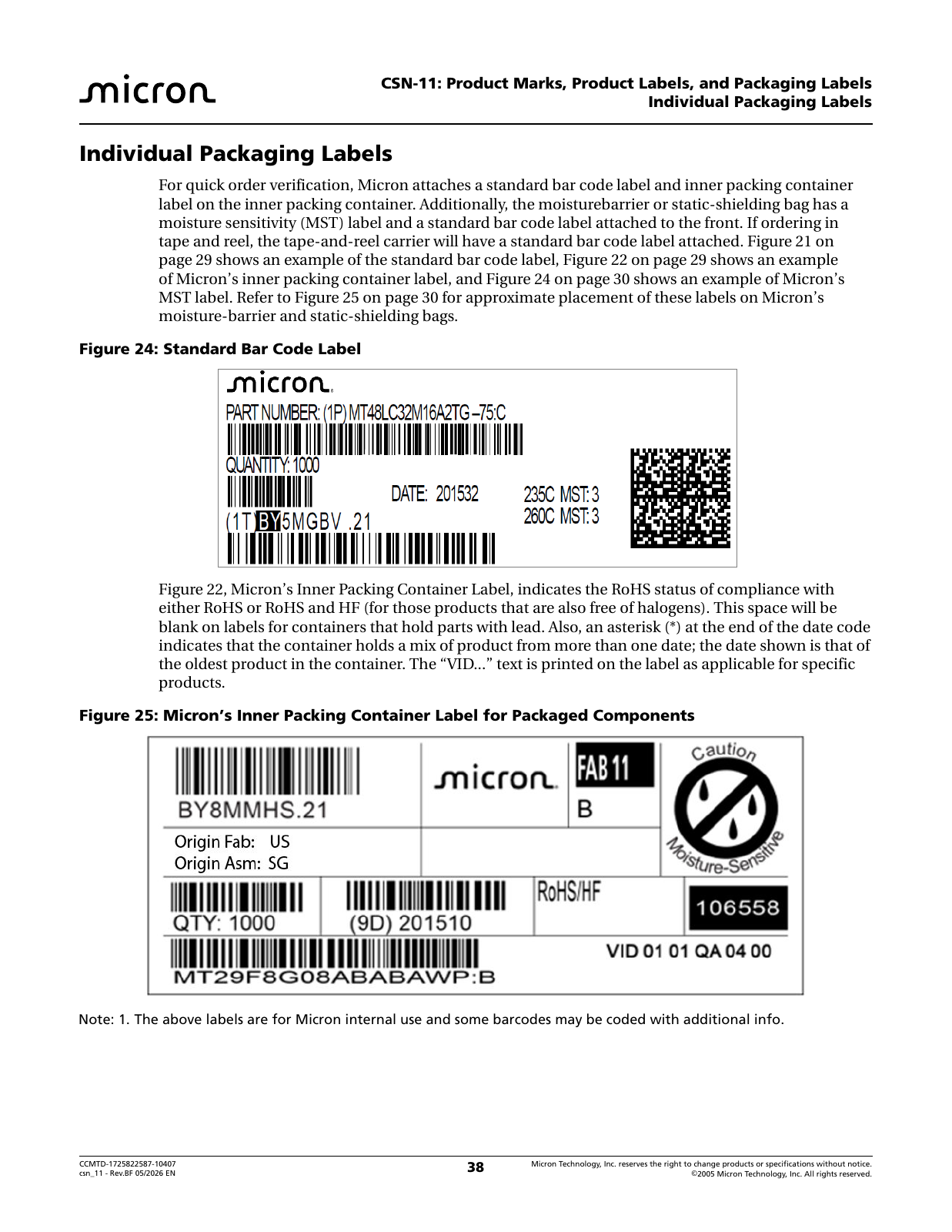
Complete part number
The part-number line preserves the full device and revision. Match your offered label to the released BOM; this older memory is only a field-reading example.
Container quantity
This is the labelled container quantity in the manufacturer example. It is not today’s available balance or the quantity committed to your order.
Trace reference
Retain the complete printed trace string with the label and the corresponding receiving record. Do not shorten it when reporting a discrepancy.
Date record
Keep this date field separate from sealing, repacking and inspection dates. Its example value does not describe the material quoted for your order.
Handling conditions
The example prints a moisture classification with temperature conditions. Use the applicable product and lot instructions; do not transfer these limits to another Micron memory.
Machine-readable record
Keep a readable image of the complete label. Micron notes that bar codes can include additional information; a successful scan alone does not authenticate the device.
Send the full label for the actual offered lot.
Discuss this requirement ↗Agree the acceptance brief before testing.
Identity, unused condition and the complete order code are essential. Your device’s programming, assembly and operating requirements still need their own checks.
Code completion
Resolve package, operating option and revision before release.
Handling
Use the actual lot’s moisture information and the assembler’s approved process.
System exercise
Record host configuration and specified memory coverage; a label check cannot establish training compatibility.
Agree the lot, sample count, method, fixture, limits, report and sample disposition. Electrical or specialised analysis depends on laboratory feasibility; it is not implied by an external visual inspection.
Send the requirement your board needs.
ICstoq reviews our inventory and established China supply relationships against the complete order code, quantity, required arrival date and destination. The quotation confirms the offered lot, inspection scope and delivery terms.
Send your enquiryInclude these details
- Complete MT53 identity including operating option and revision
- Processor, PCB and released memory-training configuration
- Trial/production quantity, handling limits and acceptance test
Identify fixed requirements and any alternatives already approved by your engineering team. We agree feasible inspection work and sample acceptance before proceeding.