Micron MT25 serial NOR purchasing
A family search for MT25 should first separate the voltage families. Then match package, density and boot behaviour, and agree whether the parts arrive blank or programmed.
Choose voltage before density.
- Voltage families
- QU / QL
- Then compare
- Density and package
- Firmware constraint
- Read / address / reset modes
- Delivery decision
- Blank or programmed
Ordering and acceptance reference · supply confirmed by quotation
Start with the requirement you already have.
The comparison helps restore the fields a family search leaves out. Follow an exact-device page where available, or send the complete code through the enquiry form.
| Order / record | What it means | Before you accept |
|---|---|---|
| MT25QU512ABB8ESF-0SIT | 512 Mbit / 1.8 V / SF package | Open the exact-device guide for the released boot requirement. |
| MT25QL02GCBB8E12-0AUT | A distinct QL / 2 Gbit requirement | Verify voltage, addressing and package; not a capacity upgrade by substitution. |
| MT25QL128ABA8E12-0SIT | A separate 128 Mbit ordering reference | Keep the complete code and board requirement. |
| Tray / tape and reel | Delivery format, separate from the device requirement | Keep the complete device code and record the required carrier on the enquiry. |
Keep the carrier with the order.
A packing instruction does not change the approved memory. Record tray or tape-and-reel delivery, lot separation and useful first quantity with the full ordering code.
Bring the design constraint into the buying decision.
Select a purchasing issue to see what needs agreement before a lot is accepted.
Recover the voltage family.
An apparently similar density can appear in a different voltage family or package. Ask for the full BOM code and board rail before comparing offers. Avoid using a programmer test to discover whether the supply assumption was wrong.
QU/QL identity, voltage, full package and speed/grade code.
Review the boot addressing sequence.
A larger flash can introduce addressing or configuration assumptions that the boot ROM does not support. Ask the firmware owner to compare reset state, read instructions and image layout for the proposed exact part. Keep a redesign approval distinct from the shortage purchase.
Host boot ROM, read/address mode and released image layout.
Agree the complete programmed state.
Specify the image checksum, intended address range, verify method and protection/configuration bits. State which operations are allowed and how failed verification is handled. A passing programmer log is still different from a successful target-board boot.
Image identity, allowed operations, verification and boot acceptance.
Solve the missing boot-memory line.
Gateway, network and industrial-control manufacturers can need a small memory quantity to release a much larger assembly. Keep the firmware and receiving conditions with the purchase so spot supply supports the existing EMS workflow.
Confirm the useful first quantity, lot separation and receiving conditions with your assembly or service team.
Plan the shortage purchaseRead the fields. Keep the device context.
Explore this Micron documentation example. It belongs to a different memory; use the offered lot’s own label to establish identity and handling requirements.
For Micron MT25 serial NOR purchasingUse the full MT25 order code on the actual offered label. Keep the packing instruction separate; the shared manufacturer example below is for another memory and does not set this part’s handling limits.
Manufacturer documentation example
Micron
Standard bar-code label example
Select a marker on the image or a number below. Each field answers a different purchasing question.
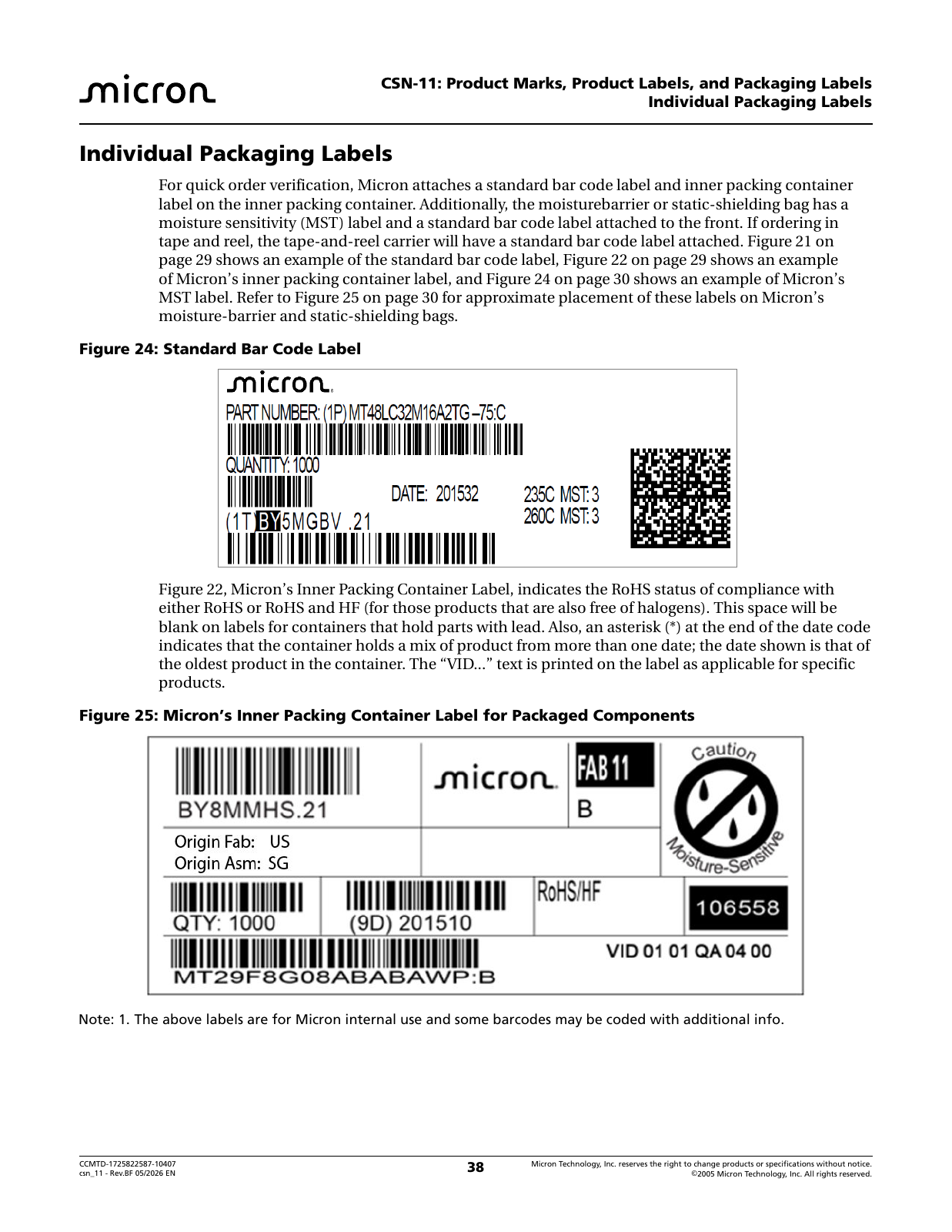
Complete part number
The part-number line preserves the full device and revision. Match your offered label to the released BOM; this older memory is only a field-reading example.
Container quantity
This is the labelled container quantity in the manufacturer example. It is not today’s available balance or the quantity committed to your order.
Trace reference
Retain the complete printed trace string with the label and the corresponding receiving record. Do not shorten it when reporting a discrepancy.
Date record
Keep this date field separate from sealing, repacking and inspection dates. Its example value does not describe the material quoted for your order.
Handling conditions
The example prints a moisture classification with temperature conditions. Use the applicable product and lot instructions; do not transfer these limits to another Micron memory.
Machine-readable record
Keep a readable image of the complete label. Micron notes that bar codes can include additional information; a successful scan alone does not authenticate the device.
Send the full label for the actual offered lot.
Discuss this requirement ↗Agree the acceptance brief before testing.
Identity, unused condition and the complete order code are essential. Your device’s programming, assembly and operating requirements still need their own checks.
Voltage / package
Match the full device before powering a sample.
Programming
Record algorithm, checksum, coverage and protection state.
Host boot
Use the intended board and controlled image for the specified boot tests.
Agree the lot, sample count, method, fixture, limits, report and sample disposition. Electrical or specialised analysis depends on laboratory feasibility; it is not implied by an external visual inspection.
Send the requirement your board needs.
ICstoq reviews our inventory and established China supply relationships against the complete order code, quantity, required arrival date and destination. The quotation confirms the offered lot, inspection scope and delivery terms.
Send your enquiryInclude these details
- Full MT25 code, QU/QL voltage family and package
- Boot ROM/read/addressing assumptions and image checksum
- Blank/programmed delivery, allowed protection operations and carrier
Identify fixed requirements and any alternatives already approved by your engineering team. We agree feasible inspection work and sample acceptance before proceeding.