LTC2941IDCB#TRMPBF
LTC2941IDCB#TRMPBF measurement depends on the external sense resistor and host scaling. A procurement test that omits the intended shunt circuit may not answer the accuracy question for your battery monitor.
Coulomb-counting monitor
- Sense arrangement
- External shunt
- Measurement chain
- Shunt value and host scaling
Ordering and acceptance reference · supply confirmed by quotation
Keep every ordering field in the comparison.
Select a code segment, then compare the offered identity with the released BOM. The source references below establish ordering context, not live availability.
| Order / record | What it means | Before you accept |
|---|---|---|
| 2941 / 2941-1 | External versus integrated sense arrangement. | Do not insert -1 as a packing variation. |
| 2941 / 2942 | 2942 adds voltage/temperature measurement functions. | Confirm the host requirements rather than accepting a family-name substitute. |
| Charge result | Shunt and firmware scaling affect the reading. | Name resistance, prescaler/scaling and integration interval. |
Resolve the decision behind the shortage.
Choose the situation that applies to your order. Each one changes what purchasing, engineering and the test owner need to agree.
Keep the external shunt in the enquiry
The IC operates as part of a measurement chain. A test without the intended sense resistor or host scaling may not answer whether the assembled monitor meets its accuracy limit.
State shunt resistance/tolerance, current range and host scaling.
Measure over a defined interval
A successful I²C read verifies communication, not charge accuracy. Define charge/discharge current, duration, reference instrument and allowed accumulated-charge error.
Give current points, interval and acceptance tolerance.
Distinguish lifecycle from a quoted lot
ADI marks the family as not recommended for new designs. A service requirement can still be reviewed against inventory and established channels, but a product listing is not evidence of present availability.
State urgent quantity, service horizon and allowed lot conditions.
Connect the label to the right record.
Explore the ADUM1201ARZ-RL7 laboratory submission label below. This is a different device, used to explain the record. The offered part needs its own manufacturer label and lot evidence.
For LTC2941IDCB#TRMPBFRequest the offered LTC2941 manufacturer reel label and confirm the full IDCB#TRMPBF string. The ADUM1201 laboratory sticker below only illustrates sample identification.
Laboratory submission label
Analog Devices
ADUM1201ARZ-RL7
Select a marker on the image or a number below. Each field answers a different purchasing question.
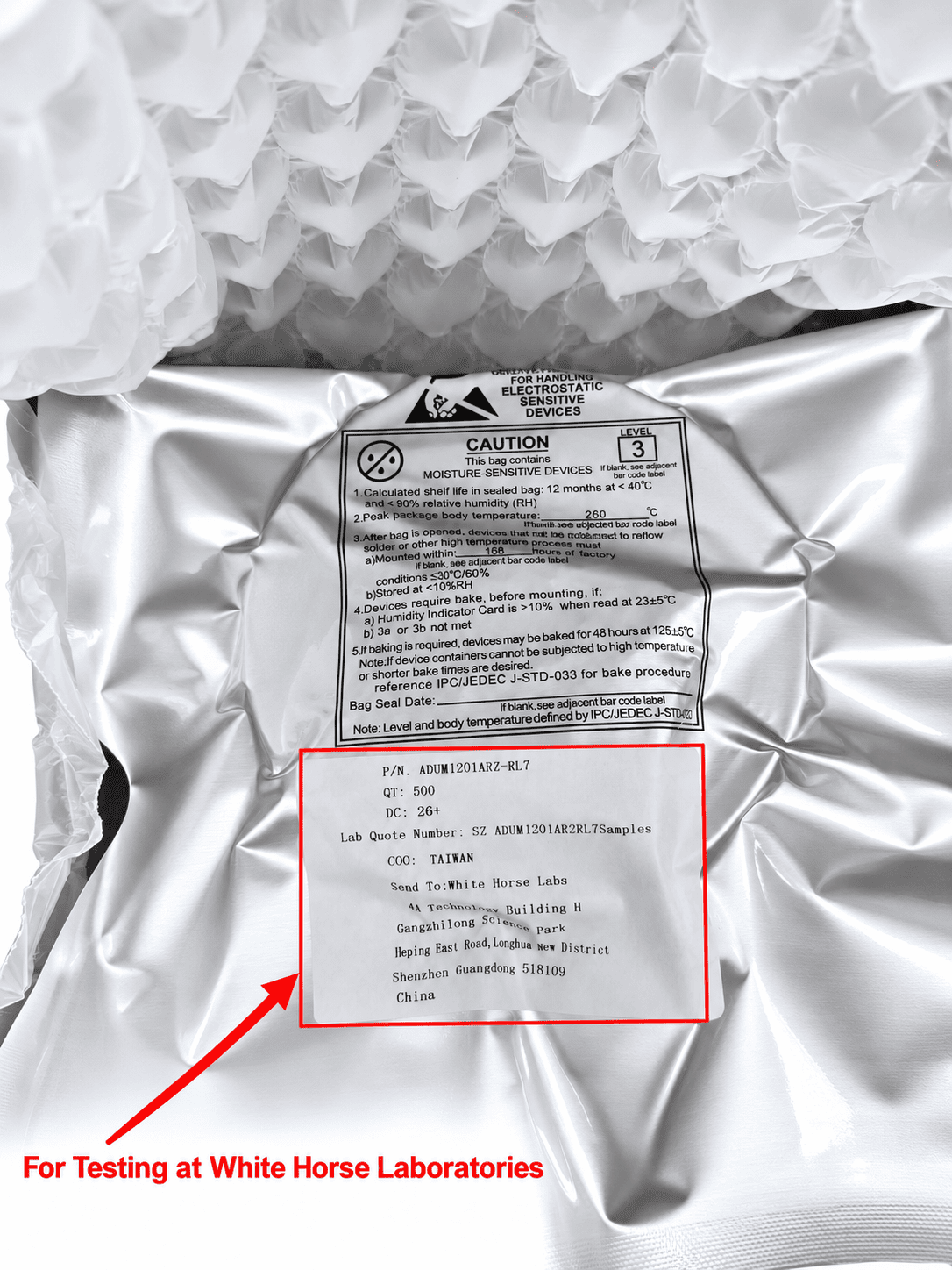
Submitted part
The P/N on this laboratory submission record identifies the material sent for review. Reconcile it with the original manufacturer label and the issued report.
Quantity and date notation
These are submission details. A date such as 25+ or 26+ is not a complete manufacturer date code, and the submitted quantity is not a live stock balance.
Laboratory reference
Use the laboratory quote or job reference to connect the submitted material with its inspection paperwork. The sticker is not the test conclusion.
Receiving laboratory
The destination identifies where this package was sent. The agreed inspection plan and issued findings are separate records.
Keep the 1201 direction configuration, A speed grade and RL7 carrier form in the requirement. Insulation testing needs its own agreed limits.
Discuss this requirement ↗Agree the acceptance brief before testing.
Identity, unused condition and the complete order code are essential. Your device’s assembly and operating requirements still need their own checks.
Identity
Keep IDCB and TRMPBF with the pack record; confirm absence of -1 for the released external-shunt circuit.
Charge measurement
Agree shunt, current direction/points, duration and host scaling before selecting a sample test.
Handling
Inspect the small DFN terminals and carrier; agree moisture and split-reel records with the assembler.
Agree the lot, sample count, method, fixture, limits, report and sample disposition. Electrical or specialised analysis depends on laboratory feasibility; it is not implied by an external visual inspection.
Put the test brief before the sample.
The laboratory workflow starts with the question to be answered. Agree how samples are identified, which operations may change them, and who reviews the findings. The photograph illustrates that workflow, not the status of an offered lot.
Explore inspection reportsSupport the board already in service.
A targeted component purchase can support your existing EMS or repair team. Keep the released circuit, calibration baseline and receiving requirements together while sourcing the missing line.
Plan an OEM / EMS shortage purchasePortable-instrument manufacturers
Exact supply can preserve the calibrated external-shunt and firmware relationship in a short build.
Battery-device service teams
A controlled service lot can support existing monitors while a later design is qualified.
Send the requirement your board needs.
ICstoq reviews our inventory and established China supply relationships against the complete order code, quantity, required arrival date and destination. The quotation confirms the offered lot, inspection scope and delivery terms.
For spot requirements on released boards and service equipment. Laboratory inspection is arranged before shipment; agree the laboratory, sample plan and test limits with the quotation.
Send your enquiryInclude these details
- IDCB#TRMPBF, quantity/date and lot constraints
- External shunt value, current range and host scaling
- Charge/discharge test interval and accuracy limits
Identify fixed requirements and any alternatives already approved by your engineering team. We agree feasible inspection work and sample acceptance before proceeding.