ATMEGA32-16AI
An old BOM calling for ATMEGA32-16AI needs more than a matching ATmega32 name. Preserve the AI option, material requirement and production programming setup when asking for a replacement lot.
Keep the original AVR requirement.
- Order option
- 16AI
- Approval owner
- Firmware + assembly
Ordering and acceptance reference · supply confirmed by quotation
Keep every ordering field in the comparison.
Select a code segment, then compare the offered identity with the released BOM. The source references below establish ordering context, not live availability.
| Order / record | What it means | Before you accept |
|---|---|---|
| 16AI versus 16AU | The archived table records the AI option. | Obtain written engineering approval for a proposed suffix change. |
| Material declaration | An old device name does not establish the offered lot’s finish or compliance. | Tell us the solder process and declarations your receiving team requires. |
| Programming record | Firmware, fuse bytes, clock and lock settings belong together. | Supply the released programming instruction, not just a binary file. |
Resolve the decision behind the shortage.
Choose the situation that applies to your order. Each one changes what purchasing, engineering and the test owner need to agree.
Preserve the working production setup.
Ask the repair or production team for the original clock source, supply and fuse record. A changed clock fuse can make a device appear unresponsive with the existing programmer even when the package identity is correct.
Board revision, programming method and fuse record.
Review the changed option before price approval.
Request the full offered label and applicable material documentation. Have engineering and the assembler compare the alternative with the old AI requirement; do not let a supplier’s abbreviated description silently change the BOM.
Whether AU is approved, and by whom.
Define usable condition with the assembler.
Date alone does not settle solderability or prior handling. Agree the storage evidence to review and whether a sample solderability check is justified before ordering a large quantity.
Date-code limit, storage record and sample disposition.
Read the fields. Keep the device context.
Explore this supplied USB5744 distributor label. It belongs to a different device; use the offered lot’s own label to establish identity and handling requirements.
For ATMEGA32-16AIThe USB5744 example below teaches label fields only. For this legacy AVR, obtain the actual ATMEGA32-16AI label, package marking and material record; the example’s MSL and seal date do not apply.
Distributor packaging label
Microchip
USB5744BT-I/2GX01
Select a marker on the image or a number below. Each field answers a different purchasing question.
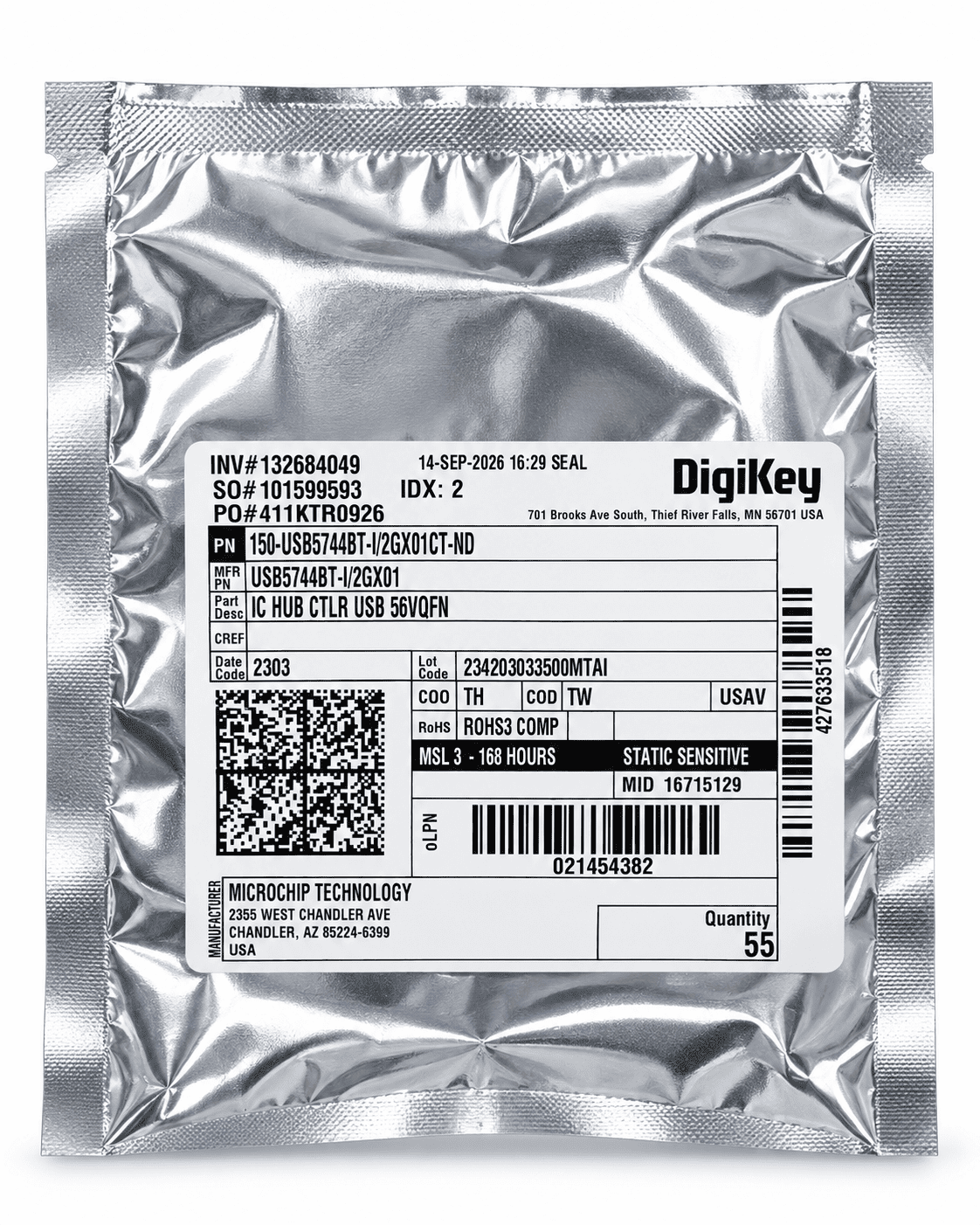
Manufacturer versus distributor code
MFR PN is the Microchip identifier. The longer PN above is a distributor catalogue code and includes its own fulfilment suffix.
Lot and date
The date and lot occupy separate fields. Keep both when asking for one-lot material or checking whether a split shipment meets your receiving rules.
Seal timestamp
This is the distributor’s seal record. It does not establish the silicon manufacturing date or the entire storage history.
Moisture handling
This USB5744 pack states MSL 3 and 168 hours. Use the requested device’s own package classification and applicable handling conditions; these values do not transfer to another device.
Pack quantity
The illustrated distributor pack carries its own quantity. A distributor cut-tape count is not the manufacturer’s standard full-reel quantity.
For this USB hub, retain /2GX01 and confirm the accepted carrier, lot and moisture-handling record.
Discuss this requirement ↗Agree the acceptance brief before testing.
Identity, unused condition and the complete order code are essential. Your device’s programming, assembly and operating requirements still need their own checks.
Lead and package condition
Record top marking, lead condition and dimensions against the correct package reference. Define treatment of bent leads, oxidation and resurfacing concerns.
Programming acceptance
Agree whether a sample may be erased or programmed. Record device identification, image revision, fuse bytes and verification result without changing security settings by default.
Board-level approval
Use the intended clock and supply, then exercise the functions needed on the service board. A programmer’s device-detect result is not a complete board acceptance test.
Agree the lot, sample count, method, fixture, limits, report and sample disposition. Electrical or specialised analysis depends on laboratory feasibility; it is not implied by an external visual inspection.
Tie a measurement to the right drawing.
The report format links measurements to identified samples and limits. For this requirement, name the correct package drawing and revision in the test brief. A dimensional pass concerns that scope, not device function or authenticity by itself.
Explore inspection reportsSupport the board already in service.
A targeted component purchase can support your existing EMS or repair team. Keep the released board, programming baseline and receiving requirements together while sourcing the missing line.
Plan an OEM / EMS shortage purchaseIndustrial controller repairs
A targeted purchase can keep an installed control board in service when a redesign or firmware migration is impractical.
Small production top-ups
An OEM or EMS may need one missing MCU line while keeping its existing board, programmer and assembly process.
Send the requirement your board needs.
ICstoq reviews our inventory and established China supply relationships against the complete order code, quantity, required arrival date and destination. The quotation confirms the offered lot, inspection scope and delivery terms.
Send your enquiryInclude these details
- ATMEGA32-16AI and any explicitly approved suffix alternatives
- Firmware revision, fuse/lock settings and clock/supply setup
- Material declaration, date-code and solderability requirements
Identify fixed requirements and any alternatives already approved by your engineering team. We agree feasible inspection work and sample acceptance before proceeding.