PD70288ILQ-TR
PD70288ILQ-TR is a dual ideal-diode bridge for PoE powered devices. Specify the bridge stage and 38-lead QFN footprint so a broad “PoE chip” offer does not become the wrong purchase.
Buy the bridge function.
- Circuit role
- Dual ideal-diode bridge
- Packing
- Tape and reel
Ordering and acceptance reference · supply confirmed by quotation
Keep every ordering field in the comparison.
Select a code segment, then compare the offered identity with the released BOM. The source references below establish ordering context, not live availability.
| Order / record | What it means | Before you accept |
|---|---|---|
| 38-lead QFN | The ordering table specifies an 8 × 8 mm package. | Compare the complete footprint and exposed-pad layout. |
| Device marking | The data sheet distinguishes the device name from a YYWWNNN trace string. | Record the whole mark; use the manufacturer’s year/week/trace definition. |
| PoE system role | Bridge measurements do not exercise the complete PD negotiation path. | Define bridge tests separately from board-level PoE acceptance. |
Resolve the decision behind the shortage.
Choose the situation that applies to your order. Each one changes what purchasing, engineering and the test owner need to agree.
Name the missing power-stage device.
Keep the PD70288 bridge requirement distinct from the protocol controller and downstream converter on the BOM. Send the exact circuit role and footprint when a supplier offers a broadly described PoE replacement.
Bridge stage, full code and board reference.
Use relevant electrical conditions.
Agree input voltage, current, polarity and the measurements needed for the bridge. Temperature or voltage-drop conclusions need the specified fixture and thermal conditions, not a photograph of the package.
Operating conditions, fixture and measured limits.
Review the surrounding circuit.
A bridge or controller with a similar purpose may need different connections or thermal design. Have the circuit owner approve the complete alternative before treating it as a shortage solution.
Approved alternatives and circuit/thermal review.
Read the fields. Keep the device context.
Explore this supplied USB5744 distributor label. It belongs to a different device; use the offered lot’s own label to establish identity and handling requirements.
For PD70288ILQ-TRFor PD70288ILQ-TR, retain the reel’s full code and device trace string. Its data sheet defines YYWWNNN; do not decode another manufacturer’s trace string using that rule.
Distributor packaging label
Microchip
USB5744BT-I/2GX01
Select a marker on the image or a number below. Each field answers a different purchasing question.
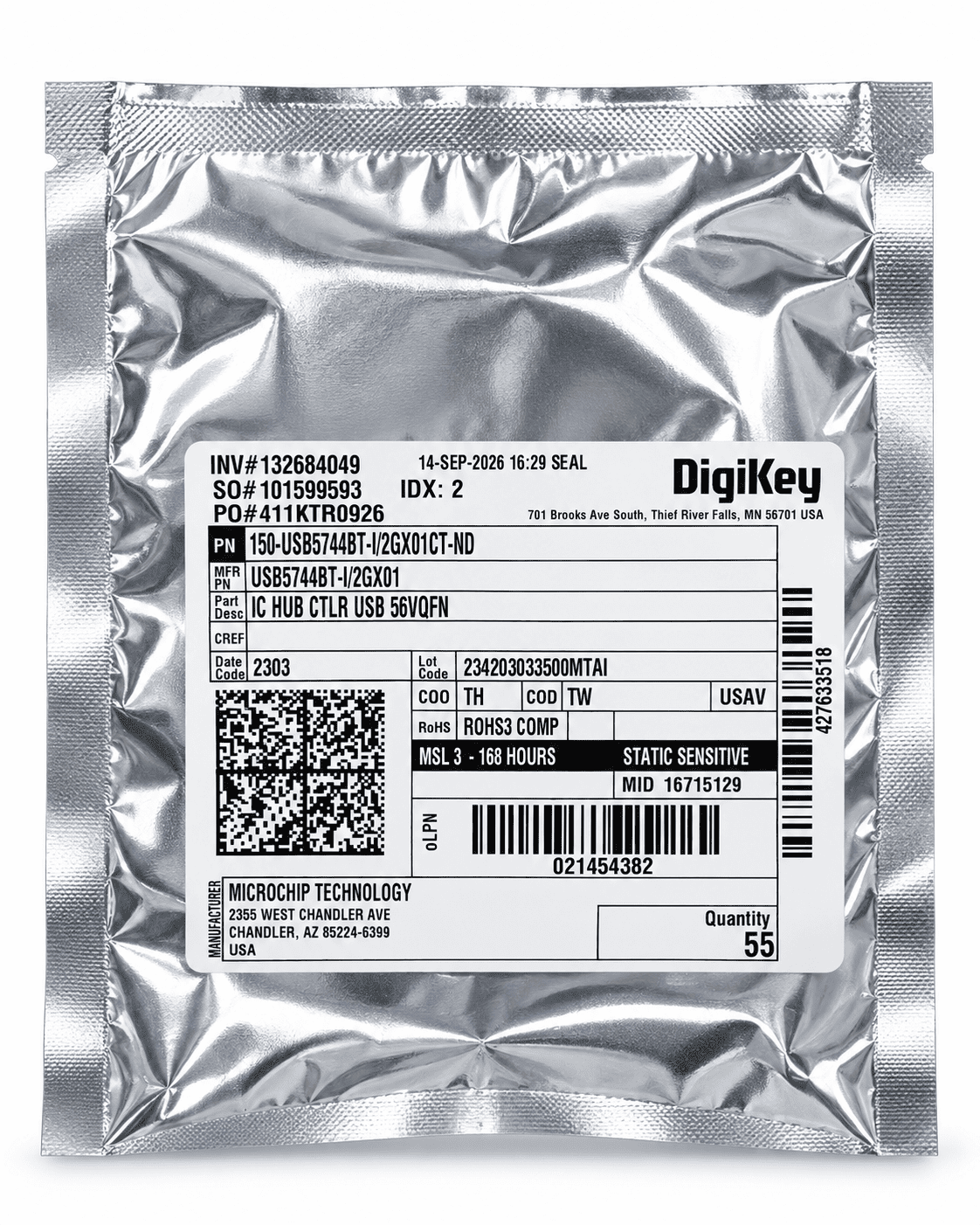
Manufacturer versus distributor code
MFR PN is the Microchip identifier. The longer PN above is a distributor catalogue code and includes its own fulfilment suffix.
Lot and date
The date and lot occupy separate fields. Keep both when asking for one-lot material or checking whether a split shipment meets your receiving rules.
Seal timestamp
This is the distributor’s seal record. It does not establish the silicon manufacturing date or the entire storage history.
Moisture handling
This USB5744 pack states MSL 3 and 168 hours. Use the requested device’s own package classification and applicable handling conditions; these values do not transfer to another device.
Pack quantity
The illustrated distributor pack carries its own quantity. A distributor cut-tape count is not the manufacturer’s standard full-reel quantity.
For this USB hub, retain /2GX01 and confirm the accepted carrier, lot and moisture-handling record.
Discuss this requirement ↗Agree the acceptance brief before testing.
Identity, unused condition and the complete order code are essential. Your device’s programming, assembly and operating requirements still need their own checks.
Package inspection
Record QFN terminals, exposed-pad condition and dimensions against the PD70288 drawing. Agree any solderability work with the assembler.
Bridge checks
Define the relevant polarity/current conditions and the voltage-drop or thermal observations to record. Confirm laboratory capability first.
System checks
If complete PoE operation is required, name the customer board and PD/PSE setup separately. A bridge-only test is not whole-system approval.
Agree the lot, sample count, method, fixture, limits, report and sample disposition. Electrical or specialised analysis depends on laboratory feasibility; it is not implied by an external visual inspection.
Tie a measurement to the right drawing.
The report format links measurements to identified samples and limits. For this requirement, name the correct package drawing and revision in the test brief. A dimensional pass concerns that scope, not device function or authenticity by itself.
Explore inspection reportsSupport the board already in service.
A targeted component purchase can support your existing EMS or repair team. Keep the released board, programming baseline and receiving requirements together while sourcing the missing line.
Plan an OEM / EMS shortage purchasePoE powered equipment
Wireless access-point and powered-device manufacturers may need the bridge line to complete an otherwise ready build.
Industrial network endpoints
A purchasing requirement can include thermal and input-stage acceptance specific to the existing equipment.
Send the requirement your board needs.
ICstoq reviews our inventory and established China supply relationships against the complete order code, quantity, required arrival date and destination. The quotation confirms the offered lot, inspection scope and delivery terms.
Send your enquiryInclude these details
- PD70288ILQ-TR, QFN38 footprint and reel requirements
- Bridge circuit, voltage/current/polarity and thermal conditions
- Bridge-only versus full-board PoE acceptance scope
Identify fixed requirements and any alternatives already approved by your engineering team. We agree feasible inspection work and sample acceptance before proceeding.