MT29F8G08ABBCAH4-IT:C
Source the 8 Gbit x8 NAND your controller was released with. Preserve ABBCAH4, IT and :C; a nearby ABACA code or another voltage option needs engineering review.
Keep the 1.8 V NAND interface.
- Package
- 63-ball
- Supply family
- 1.8 V
- Operating field
- IT
- Revision
- :C
Ordering and acceptance reference · supply confirmed by quotation
Keep every ordering field in the comparison.
Select a code segment, then compare the offered identity with the released BOM. The source references below establish ordering context, not live availability.
| Order / record | What it means | Before you accept |
|---|---|---|
| 8 Gbit x8 | Bit capacity and bus organization | Do not describe 8 Gbit as 8 GB. |
| ABBCAH4 | Exact device and package combination | Compare the rail and ball map before considering an ABACA or other code. |
| IT:C | Operating and revision requirement | Keep both fields in label reconciliation and the test brief. |
Resolve the decision behind the shortage.
Choose the situation that applies to your order. Each one changes what purchasing, engineering and the test owner need to agree.
Read the middle of the code.
The difference between ABBCA and ABACA is easy to miss in a spreadsheet. Compare the supply requirements and package mapping from the applicable documents before buying. A sample inserted into the wrong-voltage fixture is not a useful compatibility test.
Complete code, board voltage and approved package drawing.
Keep the spare area and ECC consistent.
The host may expect metadata and error-correction information in defined locations. Agree whether the programmer loads raw pages including spare data or generates it itself. Keep bad-block markers intact and use the released controller procedure.
Boot image format, spare-area policy and ECC owner.
Keep the evidence attached to each lot.
Separate labels and sampling records when the useful quantity spans more than one lot. Agree whether one qualification sample is sufficient for your process or whether each lot needs independent checks. Do not mix results into one unexplained pass.
Lot-by-lot quantity, sampling and revision acceptance.
Read the fields. Keep the device context.
Explore this Micron documentation example. It belongs to a different memory; use the offered lot’s own label to establish identity and handling requirements.
For MT29F8G08ABBCAH4-IT:CReconcile ABBCAH4, IT and :C with the offered label; the field example below is not a photograph of this device or lot.
Manufacturer documentation example
Micron
Standard bar-code label example
Select a marker on the image or a number below. Each field answers a different purchasing question.
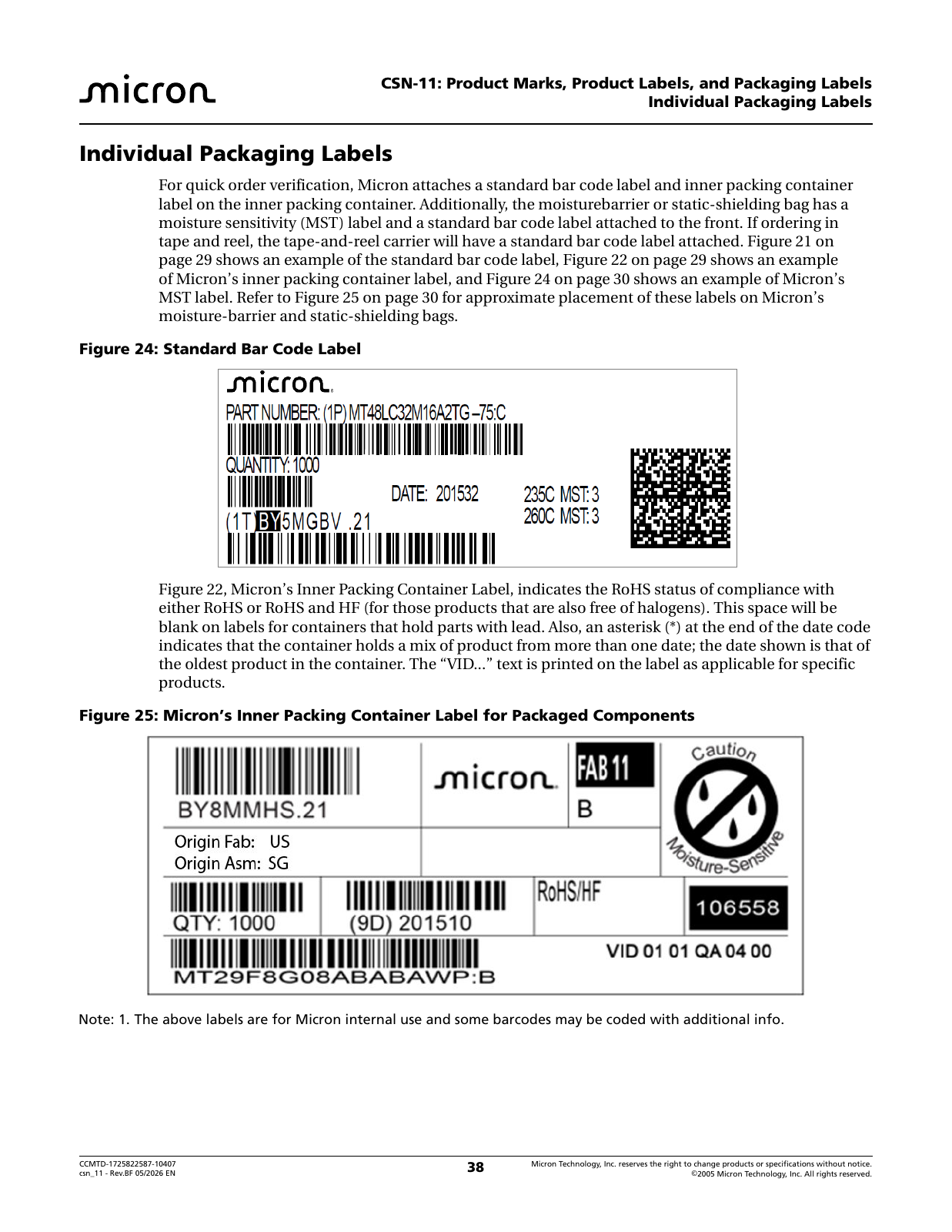
Complete part number
The part-number line preserves the full device and revision. Match your offered label to the released BOM; this older memory is only a field-reading example.
Container quantity
This is the labelled container quantity in the manufacturer example. It is not today’s available balance or the quantity committed to your order.
Trace reference
Retain the complete printed trace string with the label and the corresponding receiving record. Do not shorten it when reporting a discrepancy.
Date record
Keep this date field separate from sealing, repacking and inspection dates. Its example value does not describe the material quoted for your order.
Handling conditions
The example prints a moisture classification with temperature conditions. Use the applicable product and lot instructions; do not transfer these limits to another Micron memory.
Machine-readable record
Keep a readable image of the complete label. Micron notes that bar codes can include additional information; a successful scan alone does not authenticate the device.
Send the full label for the actual offered lot.
Discuss this requirement ↗Agree the acceptance brief before testing.
Identity, unused condition and the complete order code are essential. Your device’s programming, assembly and operating requirements still need their own checks.
Voltage and identity
Confirm ABBCAH4-IT:C and the specified rail before energising a fixture.
Package and moisture
Check the 63-ball package, ball condition and actual moisture-handling records.
Controller validation
Specify ECC, spare-area handling and the permitted read/program/erase sequence. Preserve factory markers.
Can 8 Gbit x8 be ordered as 8 GB?
No. Gbit is a bit-capacity unit; 8 Gbit is nominally 1 GB before system allocation and management overhead.
Is a programmer pass enough for boot use?
The image format and controller interpretation must also agree. Confirm boot on the intended system when that is the acceptance requirement.
Agree the lot, sample count, method, fixture, limits, report and sample disposition. Electrical or specialised analysis depends on laboratory feasibility; it is not implied by an external visual inspection.
Make package observations reviewable.
This supplied report shows how orientation and terminal observations are recorded for AD5535BKBCZ. For the requested memory, use its actual package drawing and agreed criteria; the example’s results and dimensions cannot be transferred.
Explore inspection reportsSupport the board already in service.
A targeted component purchase can support your existing EMS or repair team. Keep the released design, service setup and receiving requirements together while sourcing the missing BOM line.
Plan an OEM / EMS shortage purchaseEmbedded Linux controller boards
Flash geometry and bootloader support can keep an apparently similar NAND from being usable.
Industrial HMI service
Keep the original firmware and spare-area conventions with the service BOM.
Send the requirement your board needs.
ICstoq reviews our inventory and established China supply relationships against the complete order code, quantity, required arrival date and destination. The quotation confirms the offered lot, inspection scope and delivery terms.
Send your enquiryInclude these details
- MT29F8G08ABBCAH4-IT:C; 1.8 V and 63-ball requirement
- Bootloader/controller, ECC and spare-area image format
- Lot separation, revision limits and permitted programming tests
Identify fixed requirements and any alternatives already approved by your engineering team. We agree feasible inspection work and sample acceptance before proceeding.